Why Alt Text Matters for Shopify Seo
Most Shopify merchants spend hours obsessing over the right keywords, building backlinks, and tweaking meta descriptions — yet they leave one of the easiest SEO wins completely untouched: image alt text.
If your store has dozens or hundreds of product images with no alt text, you’re leaving rankings, traffic, and sales on the table. Here’s why alt text matters more than most merchants realize, and what you can do about it.
Table of Contents
What Is Alt Text?
Alt text (short for “alternative text”) is a short written description attached to an image. It lives in the HTML behind your storefront and is invisible to shoppers under normal circumstances — but it’s read by search engines and screen readers.
In Shopify, you can add alt text to product images directly from the product editor.
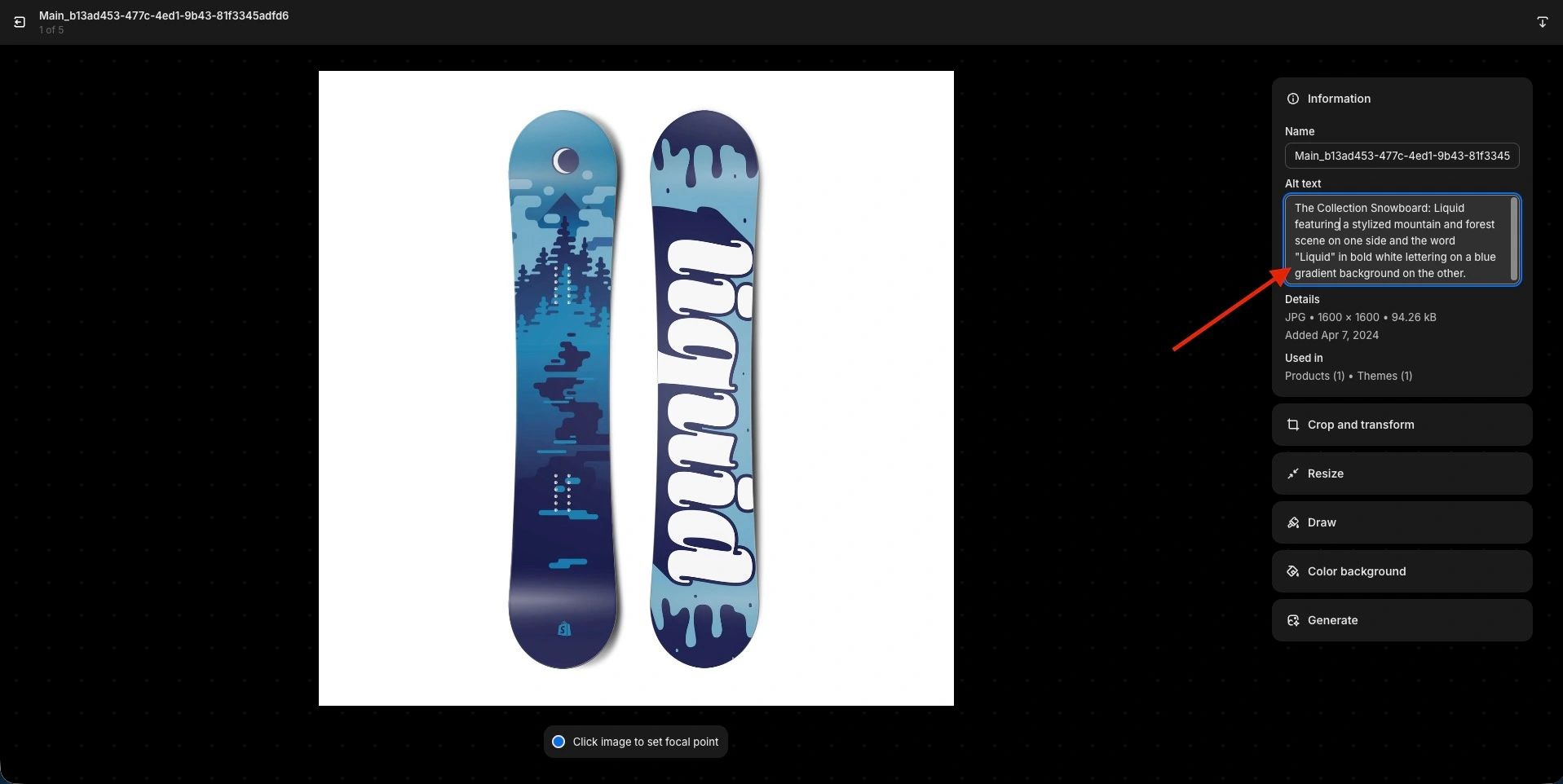
In HTML, it looks like this:
| |
Simple enough. But that small attribute has a surprisingly large impact.
Why Google Cares About Alt Text
Google can’t see images the way humans do. Instead, it relies on text signals to understand what an image contains — and alt text is the most direct signal available.
When Google crawls your Shopify store, it reads the alt text on every image to:
- Understand the content of the page. Alt text reinforces the topic of the surrounding page, adding relevance context for your target keywords.
- Index images in Google Image Search. Product images that rank in image search can drive significant discovery traffic — especially in fashion, home decor, and lifestyle categories.
- Determine ranking relevance. Pages with well-optimized alt text tend to rank better for their target queries because the text signals align with what the page is about.
In short, every untagged image is a missed opportunity to communicate with Google about what your page is selling.
The Shopify-Specific Opportunity
Here’s something worth knowing: the majority of Shopify stores have incomplete or entirely missing alt text across their product catalog.
That’s not an insult — it’s just the reality of how stores are built. When you upload product photos, Shopify doesn’t automatically generate alt text. The default is either blank or pulled from the image filename (more on why that’s a problem shortly). Most merchants never go back to fix it.
This creates a real competitive edge for the stores that do. If you sell running shoes and your product images have descriptive, keyword-relevant alt text while your competitors’ images are blank, your pages have a meaningful advantage in Google’s eyes.
Beyond product images, there are other alt text fields merchants often overlook:
- Collection page images — often set once and forgotten
- Blog post images — a missed opportunity on an already SEO-focused asset
- Homepage banners and lifestyle images — high-visibility images that frequently go untagged
Every image on your store is an opportunity. Most stores leave them all blank.
Alt Text and Accessibility — A Bonus Win
Alt text wasn’t originally invented for SEO. It was created for accessibility — specifically, to help visually impaired shoppers who use screen readers navigate the web.
When a screen reader encounters an image with no alt text, it might read out the filename (“IMG_4823.jpg”) or skip it entirely. For a visually impaired shopper trying to evaluate your product, that’s a frustrating and exclusionary experience.
Writing descriptive alt text means those shoppers can understand what your product looks like, which builds trust and increases the likelihood of a purchase.
There’s also a growing connection between accessibility and SEO. Google has indicated that user experience signals matter for rankings, and an accessible store is a better experience for everyone. Beyond rankings, accessibility is increasingly a legal and ethical consideration for online businesses.
Good alt text serves your SEO and your shoppers at the same time.
Common Mistakes Shopify Merchants Make
If you’ve started thinking about alt text, here are the pitfalls to avoid:
Leaving it blank. The most common mistake. No alt text means no signal — Google and screen readers get nothing useful from your images.
Using raw file names. Shopify will sometimes use the image filename as a fallback. “DSC_00142.jpg” or “product-image-v3-FINAL.png” tells Google absolutely nothing about your product.
Keyword stuffing. Cramming as many keywords as possible into alt text (“buy cheap blue running shoes men running shoes discount free shipping”) looks spammy to Google and is a poor experience for screen reader users. Google can and does penalize this.
Generic descriptions. “A shoe” or “product image” technically isn’t blank, but it’s nearly as useless. Vague descriptions don’t help Google understand what’s unique about your product.
What Good Alt Text Looks Like
Good alt text is descriptive, specific, and naturally includes relevant keywords without forcing them. Here are some before-and-after examples:
| Image | Bad Alt Text | Good Alt Text |
|---|---|---|
| A pair of blue running shoes | (blank) | Men’s blue lightweight running shoes with cushioned sole |
| A ceramic coffee mug | “mug” | Handmade ceramic coffee mug in matte terracotta glaze, 12oz |
| A floral summer dress | “IMG_8821.jpg” | Women’s floral wrap midi dress in yellow and white, sleeveless |
| A leather wallet | “product” | Slim minimalist leather bifold wallet in tan, holds 6 cards |
The formula is straightforward: what it is + key descriptive details + material or context where relevant. Write it the way a customer would describe the product to someone who can’t see it. Keywords tend to appear naturally when you do this well.
The Scale Problem — Why Most Stores Don’t Do This
Here’s the honest reality: if you understand why alt text matters, you probably want to fix it across your entire store. But that’s easier said than done.
A Shopify store with 200 products, each with 4–5 images, means 800–1,000 images to write alt text for. Doing that manually — opening each product, writing a description, saving, moving to the next — would take days of tedious, repetitive work. And that’s before you consider new products being added regularly.
This is exactly why most stores never get it done, even when the owner knows they should. The intent is there; the bandwidth isn’t.
This is the problem Syncor Alt was built to solve: AI-powered bulk alt text generation for Shopify stores, so merchants can optimize their entire image catalog in minutes rather than days.
Conclusion
Alt text is one of the highest-leverage, lowest-effort SEO improvements available to Shopify merchants — but only if it actually gets done. It helps Google understand your products, gets your images ranking in image search, makes your store more accessible, and strengthens the relevance signals on every product page.
The stores winning in organic search aren’t just the ones with the best products. They’re the ones who’ve taken care of the details their competitors skipped.
If you want to get your store’s alt text sorted without spending days on manual edits, Syncor Alt is launching soon — and we’re building a waitlist now.
Join the waitlist at launch.syncor-alt.com and get 50 free credits when the app goes live. That’s 50 product images with AI-generated alt text, on us, the moment you’re ready to start.
Alt Text Automation
Accurate, SEO-optimized alt texts for your Shopify store. Join the waitlist and get 50 Free Credits on launch 🎉